Learn to Surf in Bouznika, Morocco: A Beginner’s Local Guide
How complete beginners learn to surf in Bouznika, Morocco — beach break, lessons, gear, seasons, and what a first session with a local coach actually looks like.
By Mehdi Assiry ·
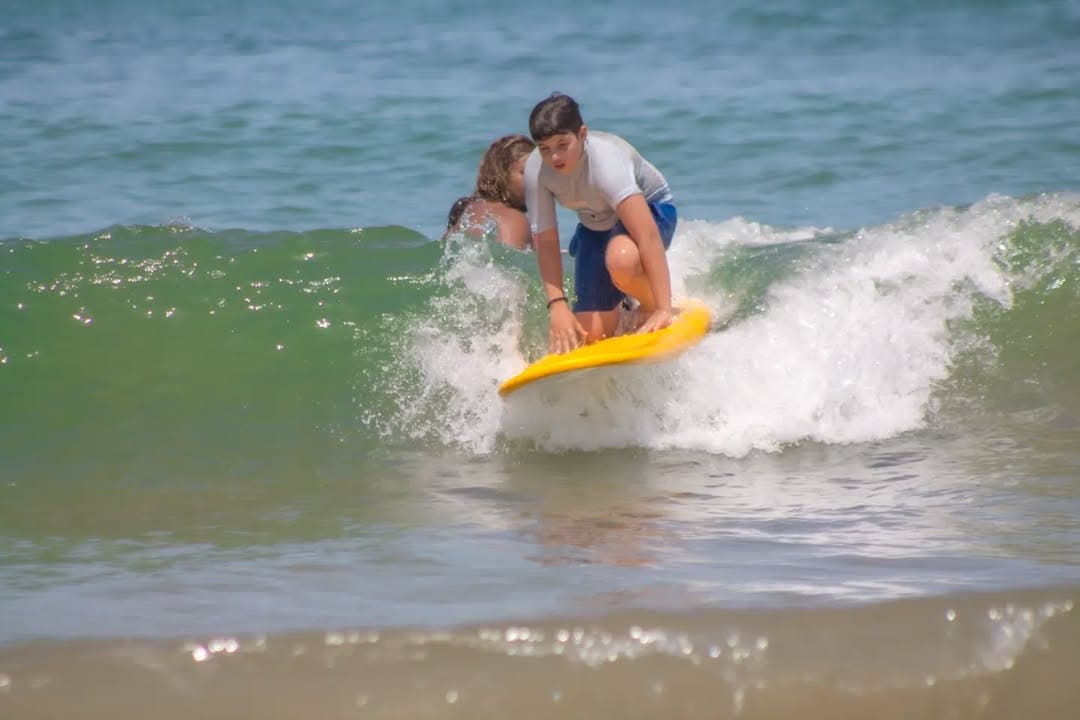
If you want to learn to surf in Bouznika Morocco for beginners, you do not need a surf-camp bus, a rental car full of boards, or a week in Taghazout first. You need a sandy beach, a board that floats you, a coach who watches your pop-up, and an Atlantic tide that is actually friendly that morning.
That is the work we do here. I am Mehdi Assiry. I grew up on this stretch of coast, I repair the boards that get wrecked on it, and I teach with Association Bouznika SurfSchool. Bouznika sits between Rabat and Casablanca — close enough for a day trip, quiet enough that a first session does not feel like a contest heat.
Why Bouznika works for first waves
A lot of “learn to surf in Morocco” articles send everyone south. Taghazout, Imsouane, Anchor Point — those names deserve their reputation. They are not always the right first classroom.
Bouznika is a beach break. The bottom is sand, not sharp reef. When you fall (and you will fall), you usually stand up in water that is chest-deep or less. The peaks move around with the sandbanks, which sounds messy until you realize it also means we can walk fifty metres and find a friendlier peak instead of forcing you onto a crowded takeoff.
The town is not a surf circus. You will share the water with local kids, a few travellers from Casablanca, and fishermen. That is a better soundtrack for a first pop-up than a pack of longboarders dropping in on you.
We still respect the ocean. The Atlantic here is cold compared with a lagoon, the wind can switch, and a rising tide can turn a mellow bank into closeouts. That is why a local in the water with you matters more than a pretty drone photo.
What a beginner lesson actually looks like
A first private or group surf lesson is 1.5 hours. We do not spend forty minutes on the sand drawing arrows in the foam. We do enough on land that your body knows the motion, then we get you into whitewater quickly, because confidence comes from standing, not from theory.
On the beach we cover:
- How to carry the board so the wind does not turn it into a sail
- Where to sit so you are not in the impact zone or in someone else’s line
- A pop-up that matches your shoulders and hips — not a yoga pose copied from Instagram
- How to fall away from the board
In the water we start on broken waves. Whitewater is slower and more predictable. You paddle, you feel the push, you stand, you look where you want to go. When that is consistent, we move you toward the shoulder of an unbroken wave if the tide and size allow it.
Board and wetsuit are included. If you bring your own wetsuit, the session is 50 dh less. Private lessons are 300 dh; group lessons are 200 dh. WhatsApp is the fastest way to book — the number is on our contact page.
Gear: you do not need to buy a shortboard
Beginners on this coast learn on soft-top foam boards, usually in the 8–9 foot range depending on your height and weight. Foam is safer when the board comes back at you, and it paddles into small peaks that a thin shortboard would ignore.
We fit a wetsuit to the season. Bouznika is Atlantic Morocco, not a tropical reef. In summer many people are comfortable in a spring suit or a 3/2. In winter you want real rubber — 4/3 is common — because sitting and waiting chills you faster than paddling. If you are unsure, we have suits in the school; do not buy a cheap ill-fitting suit the night before and suffer through your first hour.
Leash on. Wax or traction on. Sunscreen that actually stays on in salt water. That is the kit. You do not need a GoPro on lesson one.
Reading the day without becoming a forecast nerd
You do not have to memorize swell periods to learn here. You do need a coach who will cancel or shift the session if the ocean is wrong.
A good beginner morning in Bouznika is usually:
- Knee- to chest-high whitewater, not a heaving closeout
- Offshore or light wind, so the face is not chopped to pieces
- A tide that leaves a workable bank (we watch this locally; it changes)
Summer is the classic window for first-timers: smaller, cleaner, warmer air. Winter has more power and more days that are simply too much for a first stand-up. That does not mean you cannot learn in February — it means we pick the day, not the calendar. For a deeper seasonal breakdown, read the best time of year to learn surfing on the Moroccan Atlantic.
If you are driving from Casablanca or Rabat, give yourself time. A rushed lesson in a bad mood is a wasted lesson. Park, stretch, drink water, then we go.
Common beginner mistakes we fix in the first hour
Looking at your feet. The board goes where your eyes go. Look at the beach or along the shoulder.
Popping up too far back. You stall, the wave leaves you, you feel like you “cannot balance.” Often you can — you just stood on the tail.
Paddling with a flat body and a tense neck. Tired shoulders make people quit before their balance was ever the problem.
Fighting whitewater that is already done with you. Sometimes the right move is to let the soup pass and wait for the next one. Ego paddling is how you swallow water.
We correct these in real time. That is the difference between renting a board and actually learning.
After the first lesson: how to keep it
One session can get you standing. It will not make you a surfer. The people who progress here are the ones who come back two or three times in a week, or who book a surf week with villa hosting so the ocean is outside the door instead of a two-hour maybe.
Between lessons, stretch your hips and thoracic spine. Swim if you can. Watch the water from the beach for ten minutes before you paddle out on your own — where is the channel, where are people sitting, where is it closing out?
If you ding the school board, tell us. If you ding your own board later, ding repair in Bouznika is a normal part of this coast, not an emergency.
Getting here and booking
Bouznika is on the coast road between Rabat and Casablanca. Travellers fly into CMN (Casablanca) or RBA (Rabat-Salé) and taxi or train plus a short hop. We are not a hidden secret cove with no services — you can eat, sleep, and surf without a 4x4.
Message us on WhatsApp with your level (be honest: “never stood up” is a perfect sentence), how many people, and which days you have. We will tell you if the ocean looks like a classroom or a washing machine.
Learning to surf is not a personality test. It is a craft you start on a sandy Moroccan beach, with a board that forgives you, and a local who would rather you stand up laughing than look stylish and eat it.
Frequently asked questions
- Can a complete beginner learn to surf in Bouznika?
- Yes. Bouznika is a sandy beach break on the Atlantic between Rabat and Casablanca, which is a gentler classroom than many reef setups further south. We start in whitewater with a soft-top board and stay in water you can stand in.
- Do I need my own board or wetsuit?
- No. Beginner lessons include a board and wetsuit. If you already have a wetsuit that fits, bring it — we take 50 dh off the session.
- How much is a first lesson?
- A private beginner lesson is 300 dh for 1.5 hours. A group lesson is 200 dh per person for the same time. Both include coaching with Association Bouznika SurfSchool.
- Is Bouznika better than Taghazout for a first wave?
- For most first-timers, yes. Taghazout has world-class waves, but many of the famous spots are punchier and more crowded. Bouznika gives you space, sand under your feet, and a local coach who knows the tide.
Keep reading
Learn to Surf
First Surf Lesson in Morocco: What to Bring, Wear, and Leave in the Car
A practical packing list for your first surf lesson in Morocco — wetsuit, sunscreen, water, and what we already provide in Bouznika.
Learn to Surf
Best Time of Year to Learn Surfing on Morocco’s Atlantic (Bouznika Edition)
When beginners should book surf lessons in Bouznika — summer’s smaller banks, winter’s power, water temperature, wind, and how we pick a first-wave month.
Learn to Surf
How Long Does It Take to Learn Surfing in Morocco?
A realistic timeline for standing up, catching green waves, and progressing as a beginner on Morocco’s Atlantic — especially in Bouznika.